


DISPATCH 2: CROSSING THE KALAHARI THIRSTLAND - 23° 26′ S

With the clutching, soft-sand embrace of the ancient Namib behind us, we make our way down into the tree-lined Kuiseb Canyon to camp beneath baboon cliffs for another night under the stars, before reaching the Gobabeb research station, one of the world’s most important natural laboratories for understanding how life survives in the oldest desert on Earth.
Nearby, we find some of the most southerly Welwitschias, those strange desert plants that can live for thousands of years. Named after Austrian botanist Friedrich Welwitsch, who documented the plant in the 1850s, Welwitschia is famous for its extraordinary morphology and longevity.
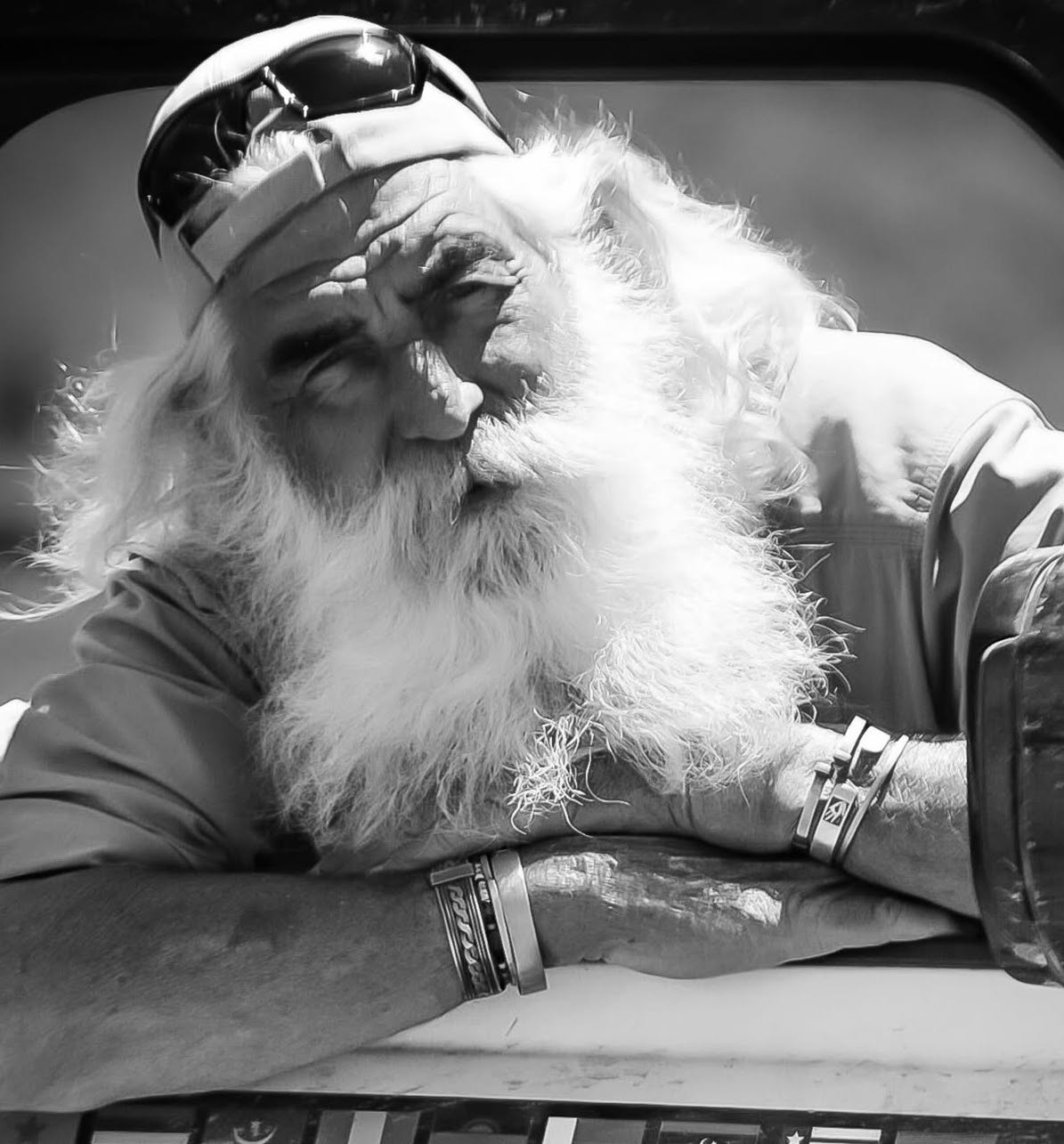
On expedition there’s humour at every turn. The Beard is chattering away on the radio, delivering a running commentary to the convoy, completely unaware that the microphone isn’t even connected. Then there’s Brad, who gets out to open a gate, walks through it, closes it behind him… and only then discovers that he’s left his Land Rover parked on the wrong side.
Good humour fuels these crazy adventures, as does another expedition tradition – the theme song for the day.
This time it’s Willie Nelson’s On the Road Again — a fitting anthem for a convoy once more heading into the wild, following the Tropic of Capricorn from the Atlantic to the Indian Ocean. Since our original 23° 26′ S crossing, the landscapes have changed, the vehicles have evolved and a few of us may have accumulated a little more mileage of our own. But the spirit and curiosity remains the same.
It’s forever eastward, a kaleidoscope of colour, light and space, purple skies and rainbows but in the distance the sky looks threatening. A tortoise crosses the road in front of the 130 Defenders – could this mean the start of rain? For the local San people, the tortoise is closely associated with rain and there may be more to the old wisdom than superstition. Tortoises become more active around rainfall, emerging from the dry landscape as the first showers approach. Out here, where rain is everything, perhaps the tortoise knows something we don’t.
The heat builds. There’s magnificent kudu, kori bustards, a huge monitor lizard and hundreds of sociable weaver nests – those extraordinary communal structures that can last more than 100 years and house up to 100 pairs of birds.
We reach the dry Nossob River and the dusty outback of Leonardville. Then, deeper into the Kalahari’s red sands, Ross finds a roadside wild camp. A Kalahari campfire, the distant cry of black-backed jackals, another perfect African night under the stars.
Our last Namibian bush breakfast is oatmeal porridge, coffee and rusks, toast on the coals with fig jam and peanut butter.

Tracks of porcupine, civet, snake and jackal lead us down a sand track for hours to the border with Botswana.
The beauty of the Kalahari in the green season is breathtaking. Not another person or vehicle in sight as we take the dusty track to reach the south-east corner of the vast Central Kalahari Game Reserve. In the late afternoon, we turn north up a cut line, stop to move a tortoise off the track, as rolling black clouds obscure the endless horizon.
The storm clouds gather daily; it’s quite incredible how we dodge the rain as the Africa Traverse convoy of battle-hardened Defenders zigzag across the Kalahari – the largest mantle of vegetated sand in the world.
With navigation holding true and having crossed into the second country of the expedition, we stop for a Tailgate Lunch at Botswana’s Tropic of Capricorn sign alongside the Trans-Kalahari highway. A Tailgate Lunch is defined as anything that fits on the tailgate or boot of a Defender – it’s generally leftover food from the previous night’s dinner, dry biscuits and bully beef, although that’s become less popular amongst expedition members after finding a tooth in one of the tins some time back.

A massive electrical storm with big cracks of lightning strikes as Ross levels the long Kalahari grass for another wild camp night – exhilarating, untamed and beautiful. Somehow, the Zen of Travel is on our side and the storm moves off, allowing us to feast on chicken and sweet potatoes cooked in the coals at a place we simply call Melon Camp, because of the proliferation of the yellow-green striped Nama melons that litter the ground.
Day after day, we follow elephant footprints down ‘middelmannetjie’ tracks, with hundreds of dung beetles and butterflies feasting on the moisture of fresh dung. The road becomes narrower, thorns scrape the sides of the vehicles, as if no vehicle had passed here for months. Even though we use capable vehicles, you don’t want to be stuck out here alone in the ‘Great Thirst Land’; there’s safety in numbers because if alone and something happens, you could die very quickly.

Then, as if by magic the landscape transforms as we reach the Makgadikgadi Pans; this was once Africa’s largest lake, larger even than Lake Victoria. The rains have already arrived here and the pans are flooded; to attempt a crossing would be foolish and our Defenders would remain a monument to a badly executed plan. We’ve learnt the hard way from experience and many days and hours of trying to recover vehicles from this giant moonscape.
We first visited the Makgadikgadi when Ross was a young teenager on a father-and-son expedition to circumnavigate these pans by land yacht; we became becalmed at a time of year the locals call ‘the Suicide Season’ because of the mind-numbing heat. It’s the closest we have ever been to near-death on an expedition. But it’s still a beautiful place with the raw immensity of one of the largest salt flats on Earth.
From the giant pans the expedition heads south to reconnect with the Tropic of Capricorn line with a stop at Khama Rhino Sanctuary. As part of our humanitarian efforts to help communities living alongside wildlife protected areas, we distribute Rite to Sight Spectacles to elderly poor sighted villagers in the chief’s ‘Kgotla’ (meeting place). It’s so rewarding to use this Defender adventure to help improve the quality of lives of others – a key ingredient of all our expeditions.
And, somewhere between the dust, the laughter and the long miles ahead, Willie sings what we already know: On the road again. Two of four Capricorn countries completed – will keep you posted.


This article is written by Kingsley Holgate, renowned African explorer, adventurer, humanitarian and author. For more than three decades, Kingsley has undertaken some of Africa’s most challenging and inspiring expeditions, travelling across remote wilderness areas in Land Rovers and using adventure to raise awareness and support for conservation and humanitarian causes. Together with his family and expedition teams, he has explored Africa’s wild places from coast to coast, documenting extraordinary landscapes, wildlife, cultures and people along the way. His expeditions have become legendary for their spirit of adventure, endurance, discovery and commitment to Africa.
Keywords: Africa Traverse, Kalahari Thirstland, Kalahari Desert, Tropic of Capricorn, Namibia, Botswana, Land Rover Defender, African expedition, Kalahari adventure, Kingsley Holgate, conservation Africa, Central Kalahari Game Reserve


