


In the Land of Kings: What Makes Zululand Feel Different
- Tariq Dube

- May 27
- 7 min read

There are parts of South Africa that take your breath away almost immediately. The road is beautiful, the light is kind, the bush is generous, and the photographs come easily. And then there are places that do something less obvious, but more lasting. They do more than just impress you. They alter the emotional atmosphere around you. Zululand is one of those places.
In northern KwaZulu-Natal, it is possible to move through sweeping valleys, ridgelines, old routes, royal country, and village landscapes and feel, almost instinctively, that this is land with memory. KwaZulu-Natal’s tourism is explicitly tied to the Zulu culture and heritage, framed through living cultural practice, royal history, and heritage sites of unusual significance.
To call it the Land of Kings is not simply a dramatic flourish. It is an acknowledgement of a region shaped by royal lineage, political memory, conflict, ceremony, and cultural depth. But what makes Zululand feel different is not only that kings once ruled here. It is that the landscape still seems to carry the shape of that history. The place does not feel emptied out by time. It feels claimed by the story.

That difference reveals itself slowly. At first, a traveller may notice the obvious things: the beauty of the countryside, the order of homesteads against green hills, the warmth of local hospitality, the rhythm of craft markets, the pull of names like Ulundi and eMakhosini. But after a while, another impression sets in. Zululand does not feel like a destination where culture is on display for visitors. At its best, it still feels like a place where identity is lived rather than staged, in language, in craft, in ceremony, in food, in social codes, in memory, and in the relationship between people and land.
That is where a fuller exploration begins.
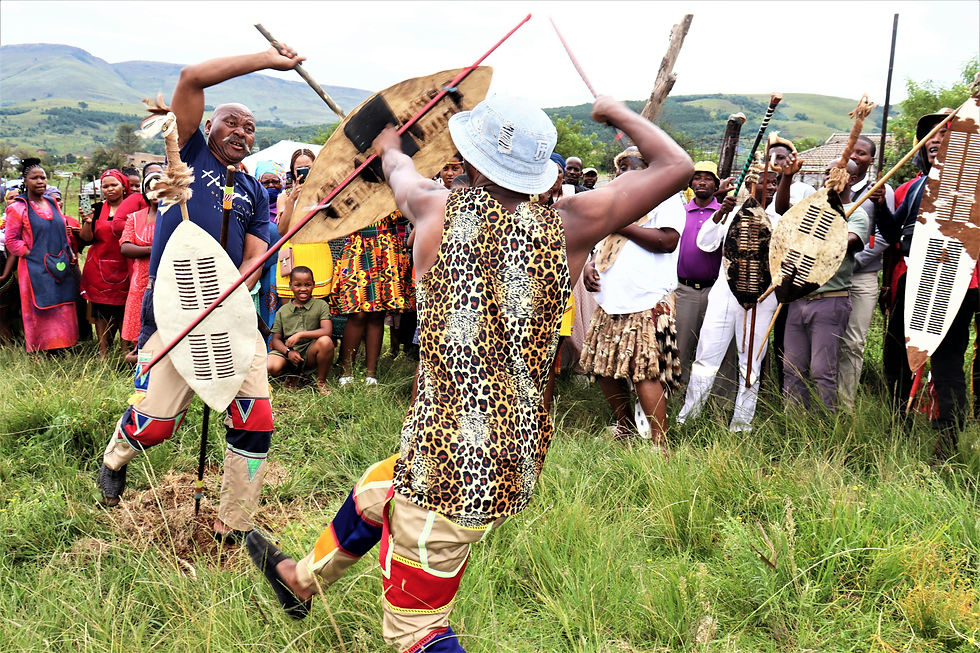
Where culture stops being abstract
One of the most accessible ways to immerse yourself in Zululand's rich culture is through the region’s cultural villages, often described as living museums. Places such as Shakaland, DumaZulu, and Simunye offer visitors a chance to begin to understand traditional homestead life, food, hospitality, healing practices, music, and customs. Not only do you get to immerse yourself in the culture, but you also get to live the adventure, taking a step back thousands of years and seeing how these majestic people lived their everyday lives.

At DumaZulu Traditional Village near Hluhluwe, for example, visitors are introduced to a version of village life structured around huts, cattle-space symbolism, craft, and hospitality. The experience is often described as a chance to learn about beadwork, basketry, pottery, weaving, dress, beer brewing, courtship and marriage customs, and ancestral beliefs.
That deep immersion is important for any traveller, as Zulu culture is not one thing; it is a whole system of meaning. The craft is not just decoration, food is not just cuisine, and dress goes beyond just aesthetics.
Even the layout of a homestead can carry social significance. If you arrive only looking for a photo, you will leave with very little. But if you arrive with questions about symbolism, hospitality, kinship, or the role of craft in everyday life, places like this can open a more grounded understanding of what culture looks like when it is lived rather than described.

This is one of the things that makes Zululand so rewarding. You can begin with something easily accessible, a village experience, a craft encounter, a guided walk, a meal, and from there you start to see how the region’s deeper historical and royal layers fit into the present.
Ulundi and Ondini: where the royal memory sharpens
Ulundi is consistently described as one of the most significant historical and cultural regions of the Zulu nation. It was established by King Cetshwayo in 1873 as a royal capital and later became the site of the final battle of the Anglo-Zulu War, after which British forces captured and burned the royal kraal. Ulundi is a key gateway into the history of kingship, resistance, and the wider story of the Zulu kingdom.

A little way from Ulundi lies Ondini, closely tied to the royal world of the Zulu kingdom. It is where visitors can find the remains of King Mpande’s kraal at Ondini, museums, and nearby historical sites that help reveal how this region was shaped. King Mpande kaSenzangakhona was the Zulu king from 1840 to 1872 and is remembered as the kingdom’s longest-reigning monarch and as the ruler who stabilised the Zulu nation after the violent struggle with his half-brother Dingane.
He came to power after fleeing Dingane, allying with the Voortrekkers, and defeating Dingane’s forces in 1840; under Mpande, the kingdom held together through a difficult period of Boer and British pressure, even as territory was lost and internal succession tensions grew. Ondini was the site of his royal kraal near present-day Ulundi, and today the remains of that kraal form part of the broader royal-historical landscape that helps visitors trace the roots of Zulu kingship and the later rise of Cetshwayo, Mpande’s son and successor.
eMakhosini: the sacred depth beneath the history
Known as the Valley of the Kings, eMakhosini is one of the most culturally charged landscapes in KwaZulu-Natal. It is a sacred place containing the burial sites of early Zulu kings, the Spirit of eMakhosini monument, and important associated sites, including uMgungundlovu, King Dingane’s royal residence, and an orientation centre where visitors can study the history of the region and the Zulu nation.

This is where Zululand begins to feel less like a destination and more like a sacred archive.
There are places in the world where history is held in documents, and others where it is held in stone. eMakhosini is one of those places where history is also held in the landscape itself, in the burial ground, in the monument, in the route, in the royal site, in the remembered geography of power and ancestry. If you visit here expecting only another heritage stop, you will miss the point. What makes this place special is not what happened there but what it means to its people.
That is why eMakhosini contributes so much to a fuller, more exploratory experience of KZN. It reminds you that this province is not only beautiful or dramatic; it is layered with sacred historical memory. To stand in a land where early kings are buried is not the same as reading their names in a guidebook. It slows you down. It gives weight to history.
The battlefields: where beauty and violence meet
One of the reasons KZN feels so rich as a travel region is that it does not offer culture in isolation from history. It blends the two into conversation.
Nowhere is that clearer than on the Battlefields Route. The official route describes itself as containing 82 battlefields, museums, old fortifications, and places of remembrance, the largest concentration of significant battle and war-related sites in South Africa. It also situates those sites within a scenic region of grasslands, game reserves, birding areas, and mountain backdrops, making the contrast between landscape beauty and historical violence impossible to ignore.

This is crucial to understanding the richness of KZN. A province that might at first appear to be defined by beaches, wildlife, and cultural tourism is also one of South Africa’s great historical landscapes of conflict. The battlefields connect visitors to the long and often brutal encounters between Zulu, Boer, and British forces that shaped the course of the region and the wider country.
The route specifically highlights internationally known sites such as Isandlwana and Rorke’s Drift, and the region’s tourism logic encourages either self-drive exploration or the use of specialist guides (like our Khaki boys, Paul and Craig) to interpret and immerse in the history of what happened there.

For a traveller, these sites contribute to a fuller, more exploratory experience because they challenge the easy separation between culture and history. They show that Zululand’s story is not only about kingship and tradition in a celebratory sense. It is also about military strategy, colonial aggression, resistance, loss, and political change. The beauty of the landscape becomes sharper, not softer, when you understand what unfolded there.
A road trip through these places has a different emotional texture from ordinary sightseeing. It makes KZN feel larger, more complex, and more morally charged. It asks the traveller to reckon with the fact that the same hills and open land that look so tranquil now were once sites of extraordinary upheaval. And that gives the region depth.
How to travel through Zululand more meaningfully
The richest way to explore Zululand is not to choose between culture, history, and scenery. It is to let them build on one another.
A fuller journey might begin in Hluhluwe with a cultural village experience that introduces visitors to craft, food, customs, and the social texture of Zulu life. From there, the route deepens in Ulundi and Ondini, where royal history comes into focus. It becomes more sacred and reflective in eMakhosini, where the Valley of the Kings reveals how much ancestral and political memory is tied to land. And then it widens again through the Battlefields Route, where the traveller sees how conflict, resistance, and remembrance shaped the province’s broader history.

Taken together, those places do more than fill an itinerary. They create a different kind of understanding.
They show that Zulu culture is not reducible to costume, dance, or symbol. They show that KZN’s beauty is not separate from its historical weight. They show that landscape can carry political memory and that heritage can still feel alive when it is tied to lived identity and local interpretation. Most of all, they show that a region becomes far more compelling when you stop treating it as a backdrop and start reading it as a layered world.
That is what makes Zululand feel different.

Not only did kings once rule here. Not only were wars fought here. Not only can visitors still find cultural villages, museums, kraals, monuments, and battle sites here. But all of those things still speak to one another. The villages, the valleys, the graves, the old capitals, the remembered routes, they do not feel disconnected. They feel like parts of one long story.
And for a traveller willing to move slowly, ask better questions, and travel with more humility than hunger, that story becomes one of the richest in South Africa.
Zululand gives you scenery, yes. It gives you heritage. It gives you atmosphere. But more than that, it gives you a way of seeing KZN as a province where culture, kingship, conflict, and memory still sit close to the surface of the land.
That is why it stays with people.
Not because it is merely beautiful.
Because it is storied.


