


Oxpeckers of South Africa: Africa's Tiny Tick-Eaters Facing Big Conservation Challenges

There's something magical about sitting at a waterhole in the African bush. While everyone's eyes are fixed on a magnificent buffalo bull or a towering giraffe, it's often the smaller stories unfolding right in front of us that deserve just as much attention. One of those stories belongs to the humble oxpecker.

At first glance they might seem like ordinary little birds hitching a free ride on Africa's largest mammals. But spend a little time watching them and you'll quickly realise they're among the bushveld's hardest-working residents. These fascinating birds have evolved alongside Africa's wildlife for thousands of years, forming relationships that are as complex as they are remarkable.
At KhakiBush, one of the things we love most is discovering these often-overlooked connections that make Africa's ecosystems so extraordinary.
Meet South Africa's Two Oxpecker Species
South Africa is home to two species of oxpecker, each with its own story and conservation journey.
Red-billed Oxpecker (Buphagus erythrorhynchus)

The Red-billed Oxpecker is by far the more common of the two species. Instantly recognisable by its bright red bill tipped with yellow, these birds are regular companions of buffalo, rhino, giraffe, zebra, kudu, impala and even domestic cattle.
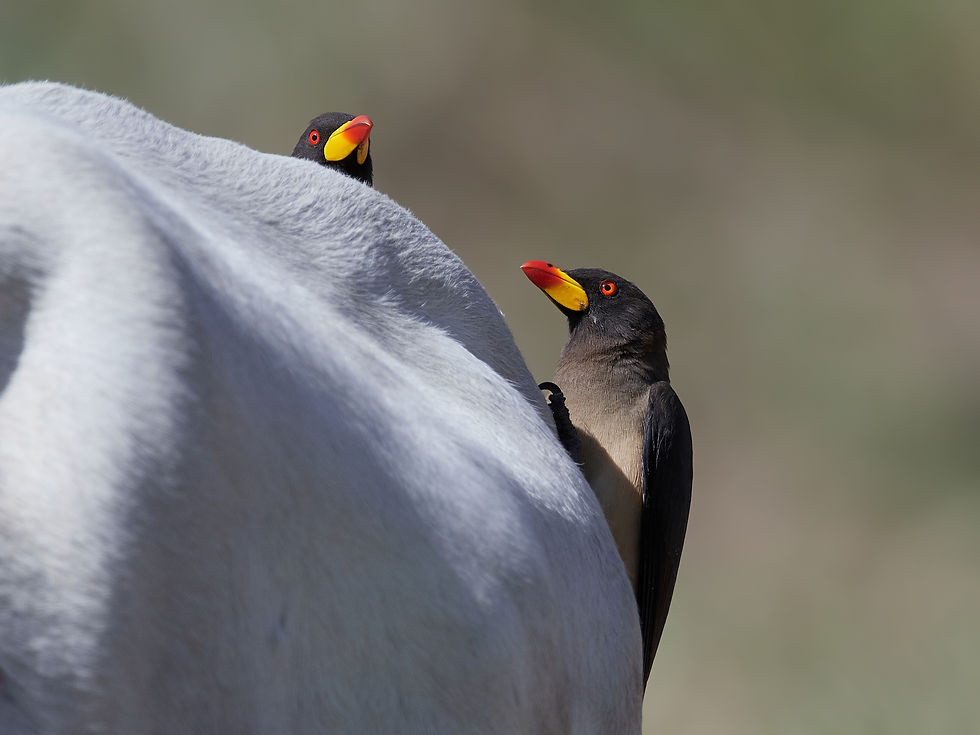
Watching them at work is mesmerising. They move effortlessly through an animal's coat, carefully picking off ticks, lice and other parasites hidden deep within the fur. Their sharp claws allow them to cling onto even the largest mammals as they walk, graze or charge through the bush.
You'll regularly spot Red-billed Oxpeckers in many of South Africa's premier wildlife destinations, including Hluhluwe-iMfolozi Park, Kruger National Park, Manyoni Private Game Reserve and numerous private reserves across KwaZulu-Natal, Limpopo and Mpumalanga.
Yellow-billed Oxpecker (Buphagus africanus)

The Yellow-billed Oxpecker is considerably rarer and slightly larger than its red-billed cousin. As its name suggests, it sports a distinctive bright yellow bill with a striking red tip.
Historically, Yellow-billed Oxpeckers disappeared from much of South Africa due to widespread habitat loss and changing farming practices. Today, thanks to successful conservation programmes and wildlife reintroductions, small populations are once again becoming established in parts of Limpopo and the Greater Kruger region.
Seeing one remains a special sighting for birders and safari enthusiasts alike.
More Than Just Tick Collectors
For many years, oxpeckers were considered the perfect example of nature's teamwork. Birds received an endless food supply while mammals benefited from parasite removal.
The reality, however, is a little more complicated.
While ticks make up much of their diet, oxpeckers will also feed on dead skin, earwax and even dried blood around wounds. Occasionally they reopen healing injuries to feed, something that has sparked debate among scientists about whether the relationship is always mutually beneficial.

Even so, there's little doubt these birds play an important ecological role by helping manage parasite loads across many large mammals.
Their sharp alarm calls also serve another important purpose.
Many game rangers and guides have watched oxpeckers erupt into loud chatter moments before danger approaches. Lions, leopards and even humans attempting to stalk wildlife often find themselves betrayed by the birds' warning calls, giving their hosts valuable seconds to react.
Why Oxpeckers Matter
Oxpeckers are far more than passengers.
Because they depend on healthy populations of large mammals, they act as indicators of ecosystem health. Where wildlife flourishes, oxpeckers often thrive too.
Their presence tells a story about functioning ecosystems, protected habitats and successful conservation efforts.
Few experiences compare to watching a breeding herd of buffalo moving through the morning mist while dozens of oxpeckers dart between their backs. It's one of those uniquely African moments that reminds you how everything in nature is connected.

The Conservation Challenges They Face
Despite recent successes, oxpeckers continue to face several significant threats.
The Hidden Danger of Veterinary Chemicals
One of the biggest historical threats came from chemicals used to control ticks on livestock.
Older pesticide formulations killed the parasites that oxpeckers depended on while also poisoning birds that fed on treated cattle. Across southern Africa, this caused dramatic declines during the twentieth century.
Although many harmful chemicals have been phased out or replaced with safer alternatives, responsible livestock management remains essential to protecting oxpecker populations.
Declining Wildlife Populations
Oxpeckers rely heavily on large mammals.
Where buffalo, rhino, giraffe and antelope disappear due to habitat loss, poaching or disease, oxpeckers often vanish as well. Protecting Africa's iconic wildlife means protecting countless smaller species that depend on them.
Habitat Fragmentation
As natural bushveld gives way to expanding agriculture, housing and infrastructure, wildlife corridors become increasingly fragmented.
This limits the movement of both mammals and birds, making it harder for healthy populations to recover naturally.

Rhino Poaching
Rhinos are among the oxpecker's favourite hosts.
South Africa's ongoing battle against rhino poaching has ripple effects that extend far beyond the loss of an iconic species. Every rhino removed from the landscape represents another important feeding opportunity lost for oxpeckers.
Conservation is rarely about saving just one species—it is about protecting an entire web of life.
A Conservation Success Story
Fortunately, there is plenty of reason for optimism.
Conservation organisations, provincial parks, private game reserves and landowners have worked together to reintroduce oxpeckers into areas where they had disappeared.
The Endangered Wildlife Trust's Oxpecker Project has played a major role in restoring both species across parts of South Africa. Through habitat protection, public education and partnerships with farmers, populations have steadily recovered in several regions.
Today, visitors to many reserves are once again greeted by the familiar sight of these energetic birds riding alongside buffalo and giraffe.
Where You Can Spot Oxpeckers
If you're planning your next safari, keep an eye out in:
Hluhluwe-iMfolozi Park
Kruger National Park
Manyoni Private Game Reserve
iSimangaliso Wetland Park
Pongola Game Reserve
Numerous private reserves across Limpopo, Mpumalanga and KwaZulu-Natal
The secret is not to look at the bird first.
Watch the buffalo, giraffe or rhino, and sooner or later you'll notice tiny flashes of movement as oxpeckers hop between ears, horns and shoulders searching for their next meal.
Every Safari Has a Story
It's easy to become captivated by Africa's Big Five, but the bush is filled with smaller characters that quietly keep nature in balance.
The oxpecker may never be the headline attraction on a game drive, yet its story is one of resilience, partnership and hope. It reminds us that conservation isn't only about protecting the biggest or rarest animals—it's about safeguarding every connection that keeps Africa's wild places alive.
At KhakiBush, we believe these are the stories worth telling. The next time you head out on safari, spend a few extra moments watching the little birds perched on a buffalo's back. You may discover that one of Africa's greatest wildlife spectacles comes in one of its smallest packages.

This article is written by Craig Mitchell, KhakiBush Magazine editor, conservationist, guide, adventurer, and explorer. Craig personally guides safari and adventure expeditions, sharing his passion for Africa's wild places through authentic wildlife encounters, remote landscapes, and unforgettable experiences.
Keywords: Oxpeckers in South Africa, Red-billed Oxpecker, Yellow-billed Oxpecker, African birds, bird conservation South Africa, safari wildlife, bushveld birds, wildlife conservation, Hluhluwe-iMfolozi, Kruger National Park, African ecosystems, KhakiBush Magazine


